
When Bans Backfire
What Australia’s Tobacco Wars Tell Us About Its Social Media Experiment

AT A GLANCE
In December 2025, Australia became the first country to ban children under 16 from social media, with 79% public support.
In three months of implementation, over 20% of Australian teens are still using banned platforms. VPN downloads have surged, and alternative apps are filling the gap. This is déjà vu with Australia’s tobacco regulation: smoking rates fell to historic lows, but illicit tobacco now accounts for ~25% of consumption, with A$7.7B in lost excise revenue.
The argument is not against regulation but against blanket prohibition. Regulating platform algorithms — not user access — may prove more effective and enforceable.
In December 2025, Australia introduced legislation that had never existed anywhere in global history. Now global society is paying attention to Australia to see what this legislation actually does for its people. The law banned children under sixteen from holding accounts or accessing social media through their own account on major platforms — Instagram, TikTok, YouTube, Snapchat, X, and half a dozen others — with fines of up to A$49.5 million for companies that failed to comply. The Sydney Harbour Bridge lit up with the campaign slogan: Let them be kids. Polling by Monash University showed 79 per cent of Australians supported the measure, and the world took notice — France, Denmark, Malaysia, Ireland, New Zealand, and the United Kingdom all began considering similar restrictions.
But for those who have followed Australia’s regulatory history, they should recall that there is a distinct sense of déjà vu. For the past decade, the country has waged an equally ambitious campaign against tobacco. Decades of advertising bans and public health campaigns had already driven adult daily smoking from around 22 per cent in 2001 to 14.5 per cent by 2014-15 — one of the lowest rates in the OECD. Then came plain packaging, aggressive excise increases, and restrictions on vaping, which pushed the rate to 8.3 per cent by the 2022-23 AIHW survey. It was a global model — until the side effects caught up. Today, according to the Australian Taxation Office, roughly a quarter of all tobacco consumed in Australia is illicit. More than 100 arson attacks in Melbourne linked to gang wars over the illegal tobacco trade. Excise revenue has collapsed from A$16.3 billion in 2019-20 to A$7.7 billion in 2024-25.
Tobacco restrictions are not the same as regulations for social media platforms, but the case may guide us where we should aim. Both share the same architecture: identify a genuine harm, then attempt to eliminate it by restricting access to its source. The question is not whether these harms are real, because they undeniably are. The question is whether blanket prohibition is the most effective instrument to address them — or whether, by cutting off supply without eliminating demand, it creates a different set of problems that may prove harder to solve.
Why the Ban Exists — And Why the Logic Makes Sense
The case for restricting children’s access to social media did not emerge from political instinct alone. It was built on a growing body of research — both domestic and international — that pointed in a troubling direction.
In May 2024, the Australian government launched a Joint Select Committee on Social Media and Australian Society. Over six months, the committee received 220 submissions and conducted ten public hearings. The evidence was consistent: 93 per cent of young Australians used social media daily, and passive consumption of algorithmically curated content was linked to depression, anxiety, insomnia, and disordered eating. The critical finding was that the harm came not from the platforms themselves but from their design — the infinite scroll, the recommendation engines, the engagement-maximising algorithms.
Australia’s findings aligned with a growing international consensus. The eSafety Commissioner reported that eleven per cent of Australian young people experienced cyberbullying, another eleven per cent faced unwanted online sexual solicitation, and that deepfake image-based abuse was occurring at least once a week in Australian classrooms.
Notably, the Joint Select Committee’s final report — titled The Good, The Bad, and The Ugly — did not recommend an age ban. Instead, it called for a statutory duty of care for digital platforms, stronger protections for personal information, and policies co-designed with young people. The Albanese government, however, moved ahead with the ban regardless, with bipartisan support from the Opposition. The legislation passed through the Senate with just twenty-four hours given for public submissions — a timeframe that drew criticism from legal and advocacy groups alike.
The platforms themselves accelerated the political momentum. During the Joint Select Committee hearings, Meta, TikTok, and Snapchat initially refused to appear, prompting lawmakers to consider issuing subpoenas. When TikTok representatives eventually testified remotely, a Nationals senator accused the company of being a “bullying behemoth” after alleging that a TikTok staff member had called his office to discourage his line of questioning. Separately, Meta unilaterally pulled out of annual news deals worth A$70 million with Australian media companies, and X owner Elon Musk publicly refused to comply with eSafety’s order to remove footage of a church stabbing, calling it “global censorship.” The cumulative effect was a bipartisan conviction that these companies would not self-regulate — and a House vote of 102 to 13 in favour of the ban.
Parents feel this acutely. A Monash University survey found that 79 per cent of Australian adults supported the age restrictions. Many described a sense of helplessness against platform algorithms engineered to keep children scrolling. As eSafety Commissioner Julie Inman Grant put it: “with the manipulative algorithms, the dark patterns, and the rabbit holes, it’s not really a fair fight.”
The government positioned the ban as a response to this asymmetry of power. Social media companies — not parents, and certainly not children — would bear the legal and financial responsibility for compliance. The intent was to shift the burden from families trying to police their children’s screen time to the corporations profiting from it.
And in the immediate aftermath, there were signs it was working. Some families reported genuine changes: smartphones left untouched on kitchen tables, children reading books, more in-person interaction. A YouGov survey a month after the ban found that 43 per cent of parents observed more face-to-face social interactions among their children, and 38 per cent reported improved parent-child relationships.
These are real outcomes. They matter. And they are precisely what makes the emerging counter-evidence so uncomfortable.
The Tobacco Precedent — When Success Breeds Its Own Adversary
Decades of tobacco regulation — advertising bans, public health campaigns, and indoor smoking restrictions — had already driven Australia’s adult daily smoking rate from around 22 per cent in 2001 to 14.5 per cent by the 2014-15 national health survey, one of the lowest among OECD nations at the time. Then the 2010s brought aggressive escalation. A one-off 25 per cent excise increase in 2010 was followed by plain packaging in December 2012, and eight annual 12.5 per cent excise increases beginning in 2013. By the 2022-23 AIHW survey, the adult daily smoking rate had fallen to 8.3 per cent — well below the OECD average of 14.8 per cent.
Then came 2024. In January, all disposable vape imports were banned. In April, advertising bans were extended to vaping products. On 1 July, the government enacted its most aggressive measure: all vapes could only be sold in pharmacies with a prescription. Convenience stores, tobacconists, and vape shops were shut out overnight. The annual 5 per cent tobacco excise increases continued, pushing the price of a legal pack past A$40.
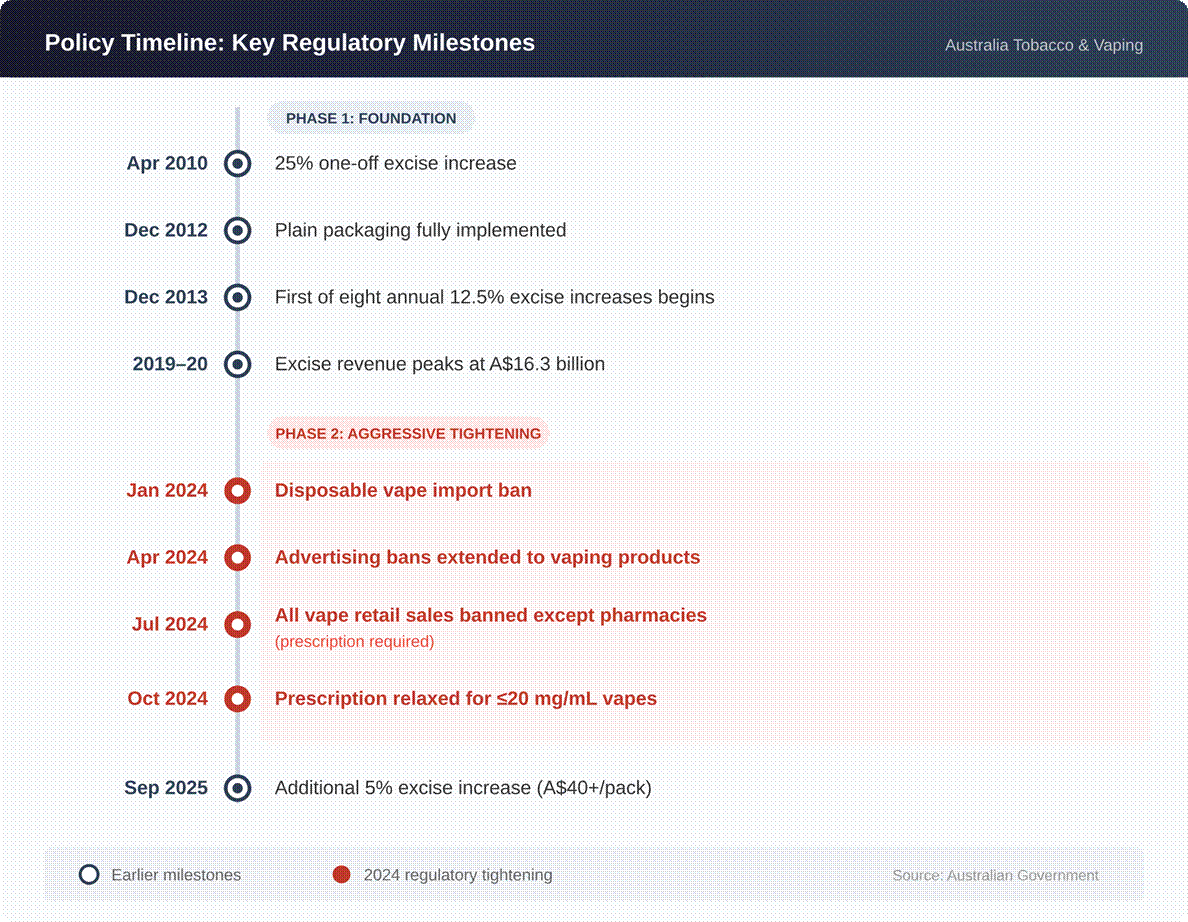
The intent was unmistakable: close every door through which nicotine could reach consumers outside of tightly controlled medical channels. The result was not what the government anticipated. Roy Morgan data from the first half of 2025 showed that smoking and vaping rates have risen since the crackdown. Among eighteen to twenty-four-year-olds, 27.8 per cent now smoke or vape — higher than the 20.7 per cent who smoked a decade ago. Illicit tobacco usage in the same age group stands at 9.1 per cent. Excise revenue collapsed from A$16.3 billion in 2019-20 to A$7.7 billion in 2024-25. The Australian Taxation Office estimates that approximately 25 per cent of all tobacco consumed in Australia is now illicit, representing a tax gap of 19.6 per cent and A$3.2 billion in lost revenue for 2023-24 — and has acknowledged that its own methodology likely underestimates the true scale. The compliance cost has been staggering: the government has allocated A$156.7 million in additional enforcement funding, established a dedicated Illicit Tobacco and E-Cigarette Commissioner, and yet over 220 firebombings linked to turf wars over the illegal trade have been recorded nationwide, with connections traced as far as Iran’s Revolutionary Guard Corps.
Key Figures at a Glance
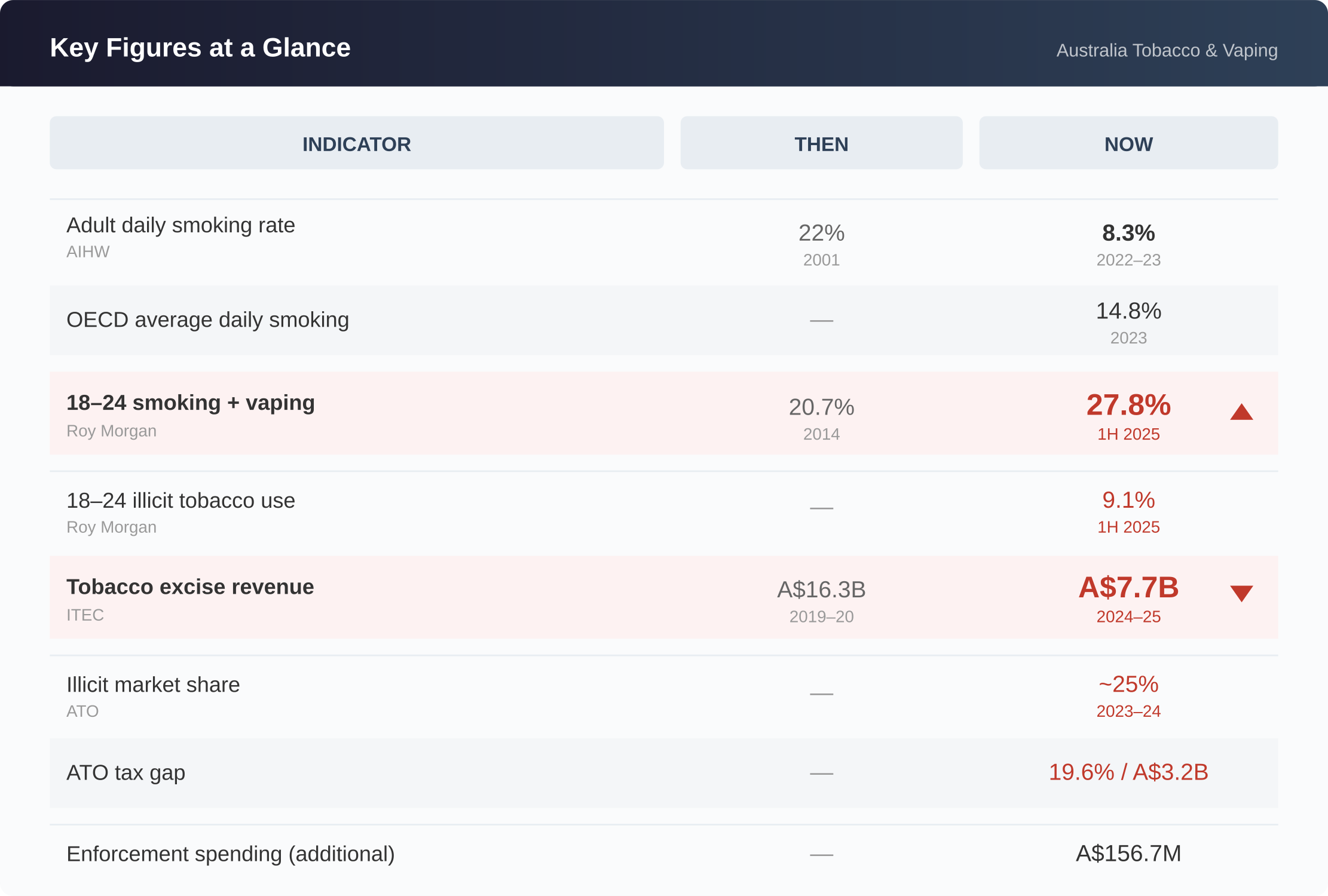
Sources: AIHW National Drug Strategy Household Survey 2022-23; ABS National Health Survey 2014-15; Roy Morgan Single Source Australia (Jan 2014–Jun 2025); ITEC Commissioner Report; ATO Tax Gap 2023-24; OECD Health at a Glance 2025.
The contrast with New Zealand is instructive. Rather than prohibiting vaping, New Zealand regulated it through licensed retail outlets, providing a legal and less harmful alternative to cigarettes. New Zealand’s adult smoking rate fell at twice Australia’s pace. The Māori smoking rate halved since 2016. The lowest socio-economic quintile saw smoking decline from 26.2 per cent to 10.7 per cent. The difference was not in ambition but in architecture: one country offered a regulated off-ramp, the other attempted a dead stop.
The lesson is not that Australia’s tobacco regulation was wrong. The decline in smoking prevalence saved thousands of lives and will continue to save more. The lesson is that regulation designed primarily around access restriction encounters a structural limit: when it succeeds in suppressing legal supply but fails to extinguish demand, it does not eliminate the problem. It displaces it — from the regulated market to the unregulated one, from tax-paying retailers to criminal syndicates — creating more severe consequences for both public health and law enforcement alike.
The Digital Balloon Effect
The social media companies that snubbed parliamentary hearings and resisted regulatory oversight ultimately complied with the ban — Meta shut down 550,000 accounts on day one, and the government celebrated 4.7 million deactivated accounts within a month. But compliance on paper and effectiveness in practice are not the same thing.
Three months in, the pattern is becoming visible. And it is familiar.
In March 2026, parental monitoring company Qustodio reported that over 20 per cent of Australian thirteen-to-fifteen-year-olds were still using TikTok and Snapchat two months after the ban. A separate Crikey analysis concluded that most teenagers who used social media before the ban were still using it, with overall usage dropping only “marginally.” Worse, initial declines were “slowly beginning to recover” as the shock of enforcement faded. Even the regulator acknowledges this. On 11 March 2026, Australia’s eSafety Commissioner Julie Inman Grant acknowledged the regulation’s limitations, saying: “Like any age restriction or limit, there are people, particularly creative teenagers, that are definitely doing a good job at getting around these.”
The mechanisms of circumvention are neither sophisticated nor surprising. Teenagers have reported fooling facial age estimation by frowning at a camera to appear older. Others have used parents’ or older siblings’ accounts. Furthermore, VPN downloads spiked in the lead-up to the ban, allowing users to mask their Australian location and avoid country-specific restrictions. And downloads of alternative platforms such as ByteDance’s Lemon8 and messaging app Discord surged in the Australian App Store since the ban entered into force. The government has since brought Lemon8 into the regulatory scope, but the pattern illustrates a fundamental challenge: every platform brought under the ban creates an incentive to migrate to one that is not yet covered. It will only provide a chance to grow the market unlawfully.
The UK offers a preview of where this trajectory leads. When its Online Safety Act took effect in July 2025, Proton VPN reported a 1,400 per cent surge in UK sign-ups. Within days, five of the top ten free apps in the UK App Store were VPNs. And here lies the critical asymmetry with the tobacco precedent: tobacco smuggling is illegal, giving law enforcement at least a legal basis for action — yet Australia has still failed to contain that black market. VPNs are legal. They are mainstream tools used by millions for corporate security, personal privacy, and protection from surveillance. A government that cannot suppress an illegal physical trade is unlikely to suppress a legal digital one. Worse, free VPNs pose their own dangers — monetising user data, lacking adequate encryption, and sometimes injecting malware. A regulation designed to protect children from data-hungry platforms may be driving some of those same children toward even less regulated data-harvesting tools.
This is the digital equivalent of what happened with tobacco. The regulated market contracted. But demand did not contract with it. It found other channels.
The Ban is not a right answer. It’s the Design.
I want to be clear about what this analysis is and is not arguing. The need to protect children from algorithmically amplified harm is not in question. The evidence of cyberbullying, online sexual exploitation, eating disorder promotion, and addictive design is real, documented, and serious. Any parent who has watched a child disappear into a feed optimised for engagement over wellbeing understands the problem viscerally. I share the 79 per cent of Australians who believe something must be done.
The argument is about method, not motive.
Australia’s tobacco experience offers a template of how well-intentioned regulation can simultaneously achieve its primary objective and generate severe unintended consequences. Smoking rates fell dramatically — an enormous public health victory. But the regulation’s reliance on access restriction through pricing created a parallel market that the Australian Taxation Office estimates now accounts for a quarter of all consumption, has required hundreds of millions of dollars in enforcement spending, and has still failed to prevent hundreds of arson attacks and connections to international terrorism financing. If it is not easy to suppress a black tobacco market, it would be much more difficult to suppress a digital workaround that is legal, encrypted, and deployable in seconds.
The social media ban’s structural vulnerability is the same: it targets access rather than architecture. It tells platforms to keep children out. It does not tell platforms to stop designing products that harm children who get in — or who turn sixteen and gain unrestricted access to the same algorithmic environment that prompted the ban in the first place. The ban also faces external pressure: most affected platforms are American companies, and Washington has already pushed back. Industry groups lodged formal complaints with the US Trade Representative, and the House Judiciary Committee chairman summoned Australia’s eSafety Commissioner to testify before Congress, calling her “a zealot for global takedowns.” In an era of escalating trade tensions, a regulation framed as child protection at home risks being received as foreign censorship abroad — an additional burden that a different regulatory approach could avoid.
There is an alternative regulatory path that addresses this gap, and it is not theoretical. Instead of banning users, regulate the algorithm:
• Mandate that platforms disable recommendation engines, autoplay, and engagement-optimising features for accounts belonging to minors.
• Require chronological feeds rather than algorithmic ones for young users.
• Prohibit the collection and use of behavioural data from minors for content targeting.
• Impose design obligations — not access restrictions.
This approach is harder to circumvent and strikes at the source of harm. A VPN can make a user appear to be in another country; it cannot change how a platform’s server-side algorithm treats that user. The problem with social media for children is not the login screen — it is the recommendation engine behind it, the system that channels a thirteen-year-old’s curiosity toward content that maximises dwell time regardless of whether that content is benign or dangerous. Design regulation also reduces the geopolitical friction: a requirement that platforms modify algorithmic behaviour for minors is a product safety regulation, not a speech restriction — more analogous to requiring seatbelts in cars than to banning cars from the road. And unlike the current ban, which shields a child at fifteen years and 364 days and fully exposes them at sixteen, design regulation can be graduated, reflecting the reality that adolescent development is a spectrum, not a switch.
None of this is to say that age-based access restrictions have no role. They may function as one layer in a multi-layered approach. But as the primary mechanism — as Australia has deployed them — they carry the same structural limitation that has plagued tobacco regulation: they suppress legal access without suppressing demand, and in doing so create incentives for circumvention that are difficult, expensive, and in the case of VPNs, legally impossible to fully counter. South Korea learned this lesson in a different domain: the country repealed its “Cinderella law” — a gaming curfew for minors — in 2021 after concluding it was ineffective. The precedent of a country that tried prohibition and reversed course deserves attention from those now rushing to replicate Australia’s approach.
If the world is going to follow Australia — and it appears many countries intend to — it should follow not just the ambition but also the lesson. The goal is right. The method needs redesign. Regulation should work to protect our kids from harmful content, not by blocking their access but by redesigning what they encounter.
Reference
Australian smoking and e-cigarette prevalence (AIHW, 2022-23): Australian Institute of Health and Welfare, National Drug Strategy Household Survey 2022-23, AIHW, Canberra. https://www.aihw.gov.au/reports/illicit-use-of-drugs/national-drug-strategy-household-survey
Australian national health survey: smoking indicators (ABS, 2014-15): Australian Bureau of Statistics, National Health Survey: First Results 2014-15, ABS, Canberra. https://www.abs.gov.au/AUSSTATS/abs@.nsf/DetailsPage/4364.0.55.0012014-15
Australian consumer attitudes survey — smoking and e-cigarettes (Roy Morgan, 2014-2025): Roy Morgan, Single Source Australia (January 2014 – June 2025), Roy Morgan Research, Melbourne.
https://www.roymorgan.com
Illicit tobacco and e-cigarette market report (ITEC, 2024-25): Illicit Tobacco and E-Cigarette Commissioner, Commissioner’s Report 2024-25, Australian Government.
Tobacco tax gap analysis (ATO, 2023-24): Australian Taxation Office, Tax Gap: Tobacco 2023-24, ATO, Canberra. https://www.ato.gov.au/about-ato/research-and-statistics/in-detail/tax-gap
Comparative health indicators across OECD member states (OECD, 2025): OECD, Health at a Glance 2025: OECD Indicators, OECD Publishing, Paris. https://doi.org/10.1787/8f9e3f98-en
Australian parliamentary inquiry into social media — final report (November 2024): Joint Select Committee on Social Media and Australian Society, The Good, The Bad, and The Ugly: Final Report, Parliament of Australia, November 2024. https://www.aph.gov.au/Parliamentary_Business/Committees/Joint/Social_Media
US Surgeon General’s advisory on social media and youth mental health (May 2023): US Surgeon General, Social Media and Youth Mental Health: Advisory, May 2023. https://www.hhs.gov/surgeongeneral/priorities/youth-mental-health/social-media/index.html
eSafety Commissioner annual report (2023-24): eSafety Commissioner, Annual Report 2023-24, Australian Government. https://www.esafety.gov.au/about-us/corporate-documents/annual-report
Public attitudes to social media regulation in Australia (Monash University, December 2025): Monash University, Public Attitudes to Social Media Regulation Survey, December 2025.
Family impact survey following social media ban (YouGov Australia, January 2026): YouGov Australia, Post-Ban Family Impact Survey, January 2026.
Australian teen social media usage following ban (Qustodio, March 2026): Qustodio, Australian Teen Social Media Usage Report, March 2026.
https://www.qustodio.com
Most teens still on social media despite ban (Crikey, March 2026): Crikey.
https://www.crikey.com.au
Parliamentary testimony on online safety enforcement — Julie Inman Grant (11 March 2026): UK Science, Innovation and Technology Committee, Oral Evidence: Online Safety, 11 March 2026. https://committees.parliament.uk/committee/135/science-innovation-and-technology-committee
VPN sign-up surge following UK Online Safety Act implementation (Proton VPN, July 2025): Proton VPN, UK Sign-up Data Following Online Safety Act Implementation, July 2025. https://protonvpn.com/blog
Longitudinal study on adolescent social media use in Australia (Black Dog Institute, 2024): Black Dog Institute, Future Proofing Study: Adolescent Social Media Use in Australia, 2024. https://www.blackdoginstitute.org.au/research/future-proofing
New Zealand smoking and vaping indicators (NZ Ministry of Health, 2023-24): New Zealand Ministry of Health, Health Survey 2023-24: Smoking and Vaping Indicators. https://www.health.govt.nz/nz-health-statistics/national-collections-and-surveys/surveys/new-zealand-health-survey
Repeal of South Korea’s gaming curfew for minors (Ministry of Culture, Sports and Tourism, 2021): South Korea Ministry of Culture, Sports and Tourism, Repeal of the ‘Cinderella Law’ (Youth Protection Act Amendment), 2021.